
A plain-language guide for landowners in Johannesburg
Rezoning, subdivision and consolidation. Explained properly.
Everything that sits between the land you own today and the development it could carry. What each application actually does, when you need one and when you do not, how long it takes, what it costs, and what it is worth at the end. Real examples from real Hyde Park properties.
Start reading Ask Devon a questionWritten by Devon Brough, who has taken sixteen developments through this process
Free, confidential, no obligation
What is your land actually worth?
Leave your name and number and I will come back to you personally with what your erf could support and what it could be worth. Most owners are surprised.
- A straight answer, not a listing pitch
- I have sold out 16 developments in these suburbs
- Nothing shared with anyone, ever
Prefer to talk now?
WhatsApp Devon
What this covers
What this covers
One
Start with your title deed
Before anyone talks about zoning, somebody has to read your title deed. Many older stands in the northern suburbs still carry conditions written when the township was laid out decades ago.

The most common one reads roughly: only one dwelling house may be erected on this erf. That condition does not stop you. It just means an extra application, called a removal of restrictive conditions, which runs alongside the rezoning rather than after it.
A real example, two erven in the same suburb
Erf 394 Hyde Park. The town planner read the deed and confirmed there was nothing restricting subdivision, so the application went straight to rezoning.
Erf 70 Hyde Park, a few streets away. That deed did carry restrictions, so the approval we hold is headed Simultaneous Rezoning and Removal of Restrictive Conditions.
Same suburb, same ambition, different starting point. The only way to know which one you are is to read the deed.
Two
Which route do you actually need?
People use the word rezoning to mean the whole process. It is not one thing, and quite often you do not need all of it. There are three separate tools and they do different jobs.
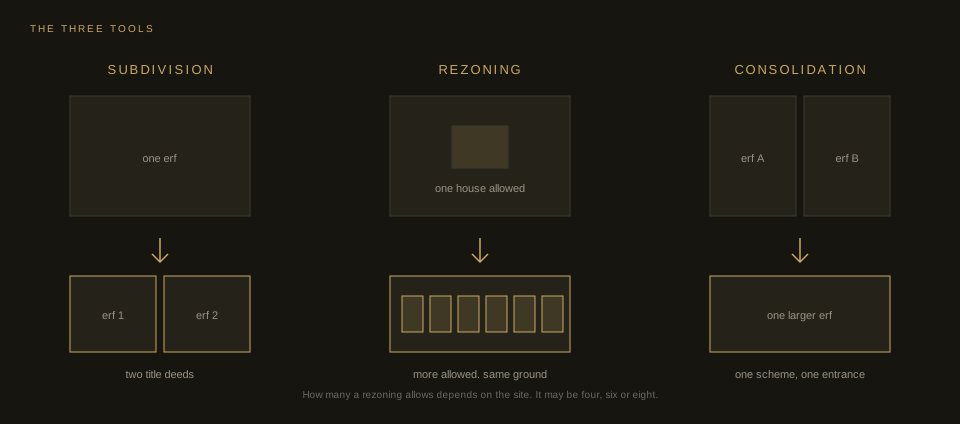
| The tool | What it changes | You need it when |
|---|---|---|
| Subdivision | Cuts one erf into two or more separately titled erven | You want to sell parts of your land separately |
| Rezoning | Changes what the land is allowed to carry | You want more than the current zoning permits |
| Consolidation | Merges two or more adjoining erven into one | You own neighbouring stands and want one scheme |
Three
When a subdivision alone is enough
If your existing zoning already allows what you want to end up with, you may not need a rezoning at all. Most Residential 1 zoning permits one dwelling per erf, so cutting one erf into two gives each new erf its own dwelling right.
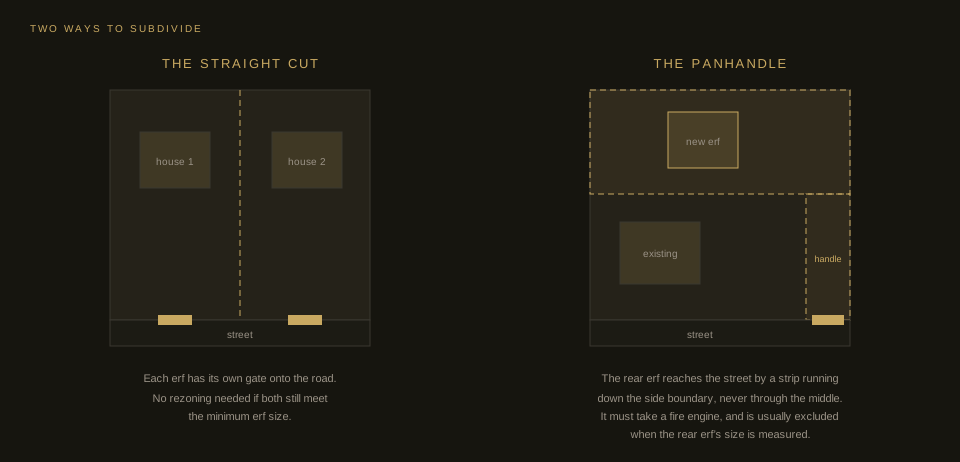
Example one, the straight cut
You own a 2,000 m² corner stand with wide street frontage. You cut it down the middle into two 1,000 m² erven, each with its own gate onto the road. Each keeps its Residential 1 right to one house.
No rezoning. One subdivision application, and you have created a second saleable property.
Example two, the panhandle
Your stand is deep with the house at the front and unused garden at the back. You subdivide off the rear portion and give it access by a narrow strip running down the side boundary to the street. That strip is the handle.
What decides whether it works is the width of the handle, which has to take a fire engine, and whether the rear portion still meets the minimum erf size once the handle is excluded.
Three things have to be true either way: each new portion meets the minimum erf size, can be independently serviced with its own water, sewer and electricity connection, and has its own legal access to a public road.
Four
When you have to rezone
You need a rezoning the moment you want more than your current zoning allows. In practice that is one of four situations.
- You want more than one dwelling on a single erf, which is the usual reason
- Your subdivided portions would be smaller than the minimum erf size for the current zone
- You need more coverage, height or floor area than the zone permits
- You want to change the use entirely, for example residential to business


A real example, Erf 70 Hyde Park
A 2,705 m² erf zoned Residential 1. As it stood, it carried exactly one house. Rezoned to Residential 2 at twenty dwelling units per hectare, the same ground carries five.
Nothing physical changed. No brick was laid. A line in the town planning scheme changed, and the land went from being worth one home to being worth five stands.
Five
Consolidation, when you own two stands
If you own two erven next to each other, consolidation merges them into a single larger erf with one title deed. It is the opposite of subdivision, and on the right site it is worth more than either stand is alone.


Density is usually expressed per hectare. Two separate stands each get their own rounded-down allocation. Consolidate them and the density is calculated across the whole, which often yields more units than the two would have carried separately.
You also design one scheme instead of two: a single entrance, one driveway, one guardhouse, one set of shared services, rather than duplicating all of it across a boundary that no longer needs to exist.
It can be applied for at the same time as the rezoning. Two conditions apply: the erven must be contiguous, and they must be in the same ownership.
Six
The applications, and the order they run in
Where a full development is intended, three applications are involved and they depend on each other. This chain is what most people do not know, and it is where timelines get lost.
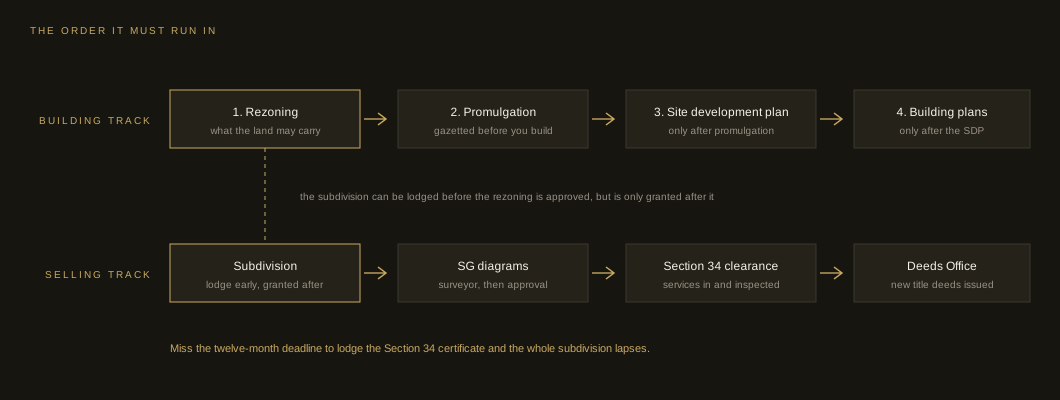
| Application | What it does | What it means for you |
|---|---|---|
| 1. Rezoning | Increases what the land may carry | Your erf allows one house. This unlocks the rest. You do not need a design to apply |
| 2. Subdivision | Cuts the erf into separately titled portions | Can be lodged before the rezoning is approved, but only granted after it |
| 3. Section 34 clearance | Council certifies every condition has been met | Without it your conveyancer physically cannot lodge at the Deeds Office |
Where this catches people
Everything is approved. The buyer has signed. And the transfer will not go through, because Council has not endorsed the power of attorney. Before it will, each new portion needs its own water, sewer and electricity connection physically installed and inspected.
We have seen a subdivision approval lapse because the certificate was never lodged in time. The condition gives you twelve months. Miss it and the whole application falls away.
Seven
How long it really takes
Roughly a year to promulgated rights on a clean application. Fifteen to eighteen months if somebody objects and it goes to the Tribunal.

Approval is the halfway mark, not the finish line. This is the single most misunderstood part of the process.
Once your rezoning is approved you still cannot build. The new rights must be promulgated in the Provincial Gazette, and the City only gazettes once development contributions have been calculated and you have been informed. Only after promulgation will Council consider your Site Development Plan. Only after that will it look at building plans.
Eight
What it costs
Most people will not give you a number. Here is a real one, from a town planning quote issued on a Hyde Park property in August 2026.
| Item | Excluding VAT |
|---|---|
| Rezoning application, professional fees | R 125 000 |
| Rezoning disbursements: council fees, advertising, gazette, site notices | R 15 500 |
| Subdivision application | R 30 000 |
| Section 34 clearance application | R 30 000 |
| Subdivision disbursements | R 1 515 |
| Town planning, total | R 202 015 |
| Including VAT at 15% | ± R 232 300 |
That is the town planner only. On top of it you will need a land surveyor, possibly a civil engineer, an architect, and municipal development contributions, which are usually the largest single line.
A real contributions figure
On one Hyde Park rezoning we have documented, the City’s external contributions came to R369,309: parks and open space R186,068, electricity R82,764, roads R48,689, sewerage R31,172 and water R20,615.
Budget in the region of R80,000 to R100,000 per additional unit.
Nine
Freehold or sectional title
Once you know what your land can carry, you have to decide how the finished homes will be owned. This choice changes what they sell for.


| Freehold | Sectional title | |
|---|---|---|
| What the buyer owns | The land and everything on it, with their own title deed | Their section, plus an undivided share of the common property |
| Who governs it | Nobody, or a homeowners association | A body corporate with elected trustees and rules |
| Monthly cost | An HOA levy where one exists, usually lower | Levies, plus exposure to special levies |
| Control | The owner decides on alterations | Trustee consent is needed |
| Maintenance | All the owner’s | Shared and handled for them |
| What you must do | Subdivide, and service each portion independently | No subdivision. One erf, one sectional plan |
| Resale here | Stronger. Buyers in these suburbs prefer it | Sells at a discount to equivalent freehold |
How we choose
Almost everything we develop in the northern suburbs is freehold, because freehold achieves a higher price per square metre here and buyers at this level want their own title deed.
The trade-off in one line: sectional title is faster and cheaper to create, freehold sells for more.
Ten
What it is worth at the end
This is the part that makes the rest worth reading.
A worked example on a 2,705 m² Hyde Park erf
Zoned Residential 1, it carries one house. Sold as it stands, comparable erven in the area have traded between R3.5m and R4.65m.
Rezoned to Residential 2, subdivided into five serviced portions and taken to market as stands, the same ground realises materially more, and the owner keeps the development margin instead of handing it to a developer.
The planning costs roughly R232,000. The contributions run to about R370,000. Against what the rights are worth, they are the cheapest money you will ever spend on that land.
The honest caveat: this does not work on every stand. Position, size, shape, access, services and the title deed all decide it, and some sites simply do not carry a development. That is worth knowing early, and it costs nothing to find out.
Want to know what your land can carry?
Send me the address. I will tell you honestly what I think it could support and what it could be worth, and if the answer is nothing I will tell you that too. No cost and no obligation.
WhatsApp Devon See what we do with landEnquiry
Find out what your land is really worth
Tell me a little about the property. The more you can share, the more useful my first response will be. Every enquiry is handled personally and held in confidence.